

[ad_1]

Wheeling Councilman Jerry Sklavounakis, City Manager Robert Herron, Mayor Glenn Elliott, Vice Mayor Chad Thalman, Councilman Ty Thorngate and Councilman Dave Palmer attend the final city council meeting of the 2023 calendar year Tuesday night. (Photo by Eric Ayres)
WHEELING – City officials in Wheeling agreed to recommend that unused funds from previously approved home improvement programs be used to help provide relief for downtown businesses struggling through the ongoing Streetscape construction.
Members of the Finance Committee of Wheeling City Council met Tuesday night to discuss a funding source for the lost revenue component of the proposed relief program. Two weeks ago, members of the Development Committee of Council heard and supported the proposal from City Manager Robert Herron to provide up to $10,000 to each affected business for lost revenue reimbursement, as well as Business & Occupation Tax relief during the construction period.
Downtown business owners have expressed concerns over the impact of the sprawling Downtown Streetscape Project, a $32 million West Virginia Division of Highways project that is bringing a complete overhaul of downtown Wheeling’s streets, curbs, sidewalks, stormwater management systems, traffic signalization systems and other features. The massive construction zones, closed streets, limited parking availability and traffic detours have had a negative impact on customer traffic to small downtown retailer businesses and restaurants.
The recommended allocation for the proposed relief program is $300,000, and a handful of suggestions for funding sources was given to the Finance Committee Tuesday night. Officials chose to use leftover funds from completed homeowner improvement programs instead of cutting into an upcoming street paving contract. One option was to reduce the street paving budget from $800,000 to $500,000, but that avenue was met with a dead end in terms of council support.
“The Pre-1940 Homeowners Repair Program – which had a sunset deadline I believe of June 30 on it – has $92,514 remaining,” Herron said. “Those funds cannot be committed to that program unless council amends the deadline date.”
Even more funds remain in another home repair program, Herron noted.
“In the Homeowner Improvement Program – which ran for about 16 months and was concluded in November – there’s $272,955,” he said. “If we combine those two, there would be $365,470 available for re-appropriation without cutting into any program that city council has already approved.”
Herron explained that the city had not yet awarded a contract for street paving for this fiscal year – which presented the other funding option. He said the contract was ready to go out to bid this fall, but the bidding price would have been inflated because the vast majority of work in the contract would not take place in the spring. The city’s most recent street paving contractor, Cast & Baker, would not have been able to complete 20% of the next paving contract before the end of this calendar year, Herron noted.
“So we chose not to bid it in the fall,” Herron said of the next city paving job. “Everything is ready to go. All the streets have been identified, which took a lot of work this year. We anticipate bidding that in February for city council consideration in March.”
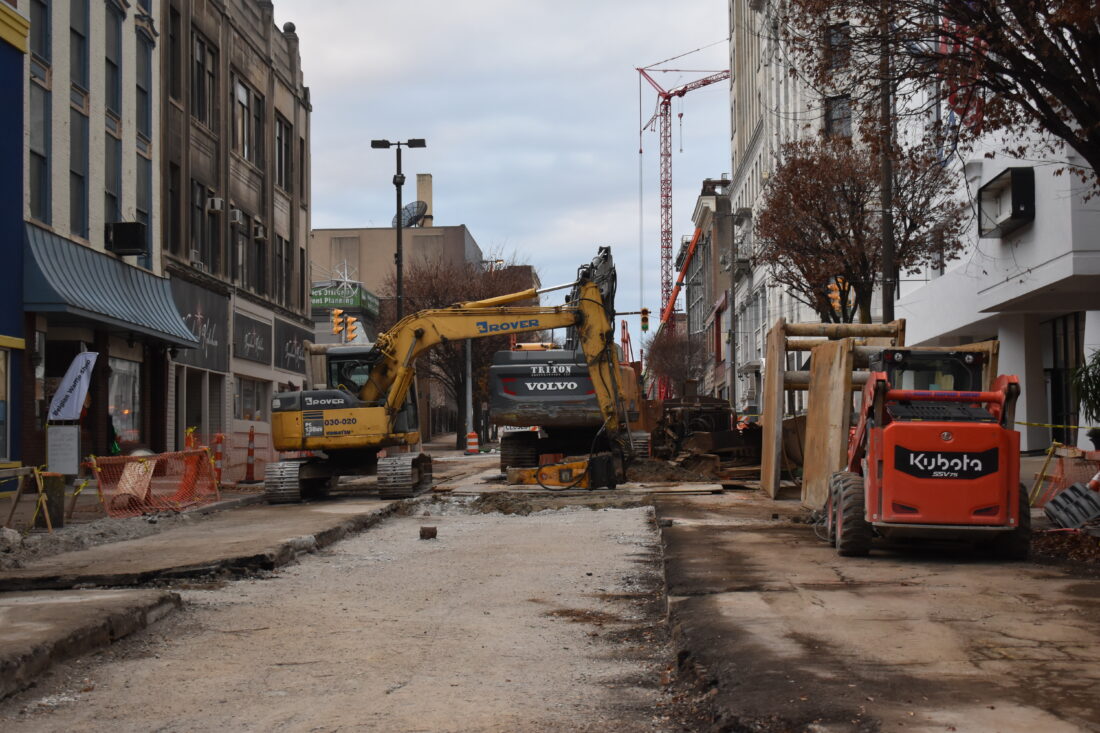
Businesses along portions of Market Street in downtown Wheeling have been struggling to keep customers coming through their doors because of the massive amount of work taking place as part of the Downtown Streetscape Project. (Photo by Eric Ayres)
Councilman Ty Thorngate and Vice Mayor Chad Thalman both expressed no desire to tap into the paving budget to help fund the Streetscape relief program.
“I’m more than happy to use the Victorian program and the Homeowners Assistance. I would much rather do that than eliminate paving,” Thorngate said.
“I don’t want to eliminate any paving,” Thalman added, noting that using the excess funds from the home improvement programs was the best option. “Those programs, again, are completely run out. This is just money that’s left over that would have to be reabsorbed back into the budget in some way, shape or form.”
The committee agreed to recommend a budget revision for those home improvement programs to redirect that money and set up the new relief fund. The budget revision is expected to be considered by city council at a council meeting in January.
During Tuesday night’s full city council meeting, a first reading on an ordinance was heard to create the short-term relief program. A second reading and final vote is expected during council’s Jan. 2 meeting.
Twenty one downtown businesses are expected to be eligible for the program. Small retail businesses must be located in the impacted area between Main and Market streets (which are part of W.Va. Route 2) from 10th Street to 16th street, including the connecting cross streets. Eligible businesses must take in less than $1 million in annual sales.
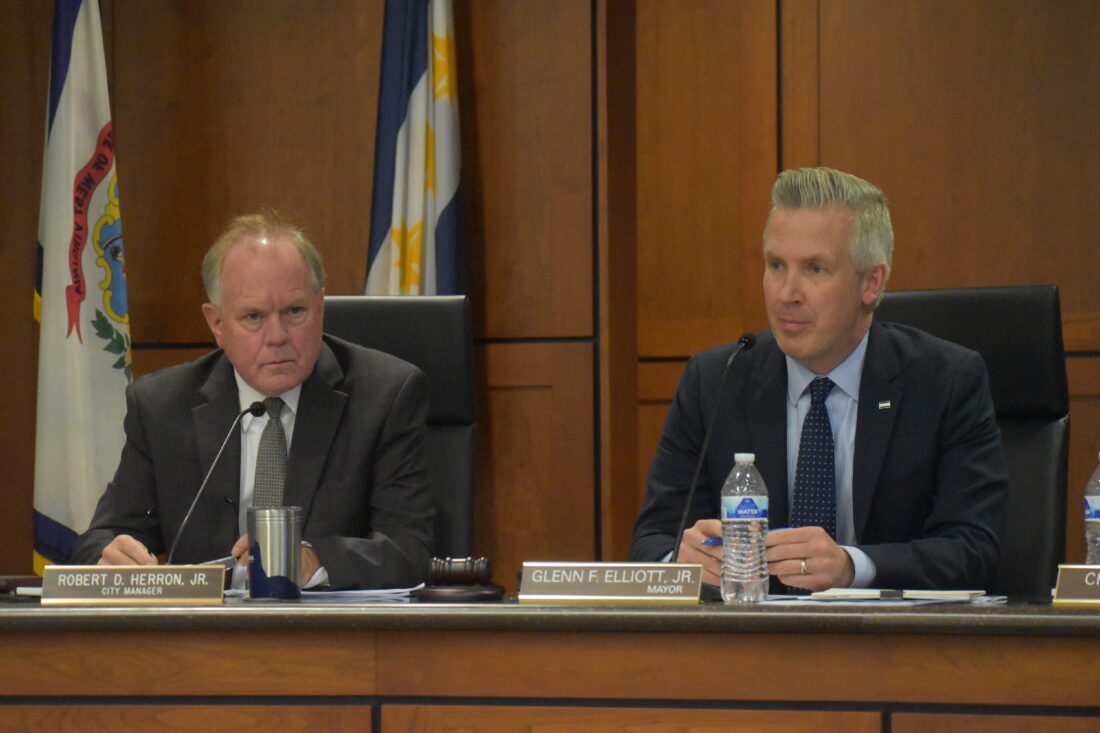
Wheeling City Manager Robert Herron and Mayor Glenn Elliott attend the final city council meeting of the 2023 calendar year Tuesday night. (Photo by Eric Ayres)
Eligible business owners can apply for up to $10,000 in lost revenue relief. City leaders will use the higher of each business’s reported revenues for non-COVID years of 2019 or 2022 for comparison to estimate lost revenue figures. The program allows for other determining means of estimated revenue loss if any business is newer and does not have reported revenues from the previous years as a reference.
The proposed program will also allow eligible businesses to apply for 50-percent credit against B&O Tax normally due for applicable time periods during the construction. The period will be retroactive to July of this year and will include fiscal quarters through the projected end of the Streetscape project in July 2025.
“I’m very pleased to see on the agenda tonight the assistance package that we asked the city manager to put together,” Mayor Glenn Elliott said. “I know folks are hurting out there.”
The mayor encouraged everyone to continue supporting the downtown businesses despite the inconvenience of the construction.
“If you’re choosing not to come down because you think it’s too hard to get around – unless you are disabled, it’s really not that much different,” he said. “You just need a little bit of extra time – maybe five or 10 minutes. But please do not forget about your downtown restaurants and retailers here, especially during this time of the season. For a lot of them, it’s when they make a big chunk of their income.”
[ad_2]
Source link
